Pages

Friday, January 25, 2013

Pepsi Salty Watermelon from Japan!

Pepsi Salty Watermelon is definitely my favourite carbonated drink! ^^ However, I have to warn you that I like it so much only because of its unique flavor. I'm not the best person to talk about the quality of carbonated drinks. :)

Pepsi Salty Watermelon from Japan
In fact, this version of Pepsi is not new. It was released on July 24, 2012, sold for a limited time only, to celebrate the enjoyment of summer. It came in 490ml bottle with a label showing 2 big watermelons and white sand beach in the background.

Pepsi Salty Watermelon on the rack
Talking about summer, summer season is very precious here because, as an island blessed by powder snow for around 5-6 months per year, Hokkaido citizens enjoy relatively short summer season compared to other parts of Japan.

However, we should not forget that Hokkaido is extremely pretty the whole year! One of the many attractions of Hokkaido is its four distinctive seasons which offer different scenery, food and activities. The beauty has been drawing large number of both local and foreign visitors every year. Just keep in mind that if you plan to visit Hokkaido, decide what you want to see here first and plan your trip early because certain things exist strictly during certain period of the season! Flowers, especially.

Since Pepsi Salty Watermelon was released on July 2012, let's see some pictures taken around July last year. :)

Lavender garden at Furano, Hokkaido
I loveee this picture so much! ^__^

Sunflower garden at Biei, Hokkaido

Shimamui beach and its Shakotan blue 
You can find my post about Shimamui beach and Shakotan peninsula here.

Besides the beautiful scenery, summer in Japan is full of events and activities. One of the most popular ones is fireworks display or "Hanabi Taikai". If you visit Japan on July or August, you can see a lot of fireworks display everywhere in Japan, hold mostly every weekend for around a month. You will also be able to see the Japanese people (and foreigners, as well !) wearing yukata, which is a casual summer kimono, while watching the fireworks.

Fireworks display is one of the popular events for dating :)
Watching fireworks at Toyohira river :)


Purikura (Photo box) session after! ^^
Back to Pepsi Salty Watermelon, it is the first pepsi I bought a lot for my own collection. Although I don't like carbonated drinks, drinking a sip of this pepsi salty watermelon from time to time gave me such a unique feeling of getting back the memory of our precious summer during the colder days. Besides, i think the color is quite special for pepsi. I'm quite sad to see that it expired quite fast. :( I have 2 bottles left with me and I still keep them although they are already expired. =P

Pepsi Salty Watermelon's expiry date :(
Nutritional value
I have never tried salted watermelon in my life to be honest, hehe. I will definitely try it next summer! ^^ For you who have never tried salting your watermelon, it is said that salting a watermelon which is not sweet enough will make it taster better and sweeter. It seems to work for apples, as well! However, keep in mind that you shouldn`t put too much salt like when you eat french fries!

Pepsi White and Pepsi Salty Watermelon from Japan

If you are also interested to see other limited edition drinks,
don't forget to check my posts about:

1. Japan's Pepsi Franky Cola which is another latest special edition Pepsi based on famous Japanese shounen manga series, One Piece (ワンピース)
2. Japan's summer edition Pepsi Black Lemon with all-black Pepsi logo, a bit of lemon flavor and 50% less sugar content
3. Japan's latest winter edition Pepsi White launched on December 11, 2012
5. Coke Zero 007 Skyfall Special Edition

Tuesday, December 18, 2012

Star Wars earphones

star wars earphones

star wars earphones

I found these cute star wars earphones at PLAZA stores during our xmas gift hunting. ^__^ They came in 3 designs: darth vader with red ear plugs, storm troopers with black ear plugs, and R2D2 with blue ear plugs, with no microphone.

It was 8.30PM already that time and we were in Odori. You might think that it's not late at all, but the shops here are usually closed at around 8.30 or 9PM. I needed to buy more things in Tanukikoji and Sapporo Station, while Javier wanted to buy these earphones in PLAZA which has branches in both Odori and Sapporo Station. Too bad the PLAZA store in Odori were closed already, so I rushed to Sapporo Station  like crazy, hoping that the shops were still open, while Javier went to Tanukikoji to buy my stuffs.

Luckily the shops were open a bit longer for xmas... until exactly 9PM, i mean =P hehe, but then I had to finish my business in 2 stores in like 15 minutes!! I rushed to the star wars section, took some pictures and texted him so Javier could make proper decision since he hadn't seen these stuffs himself. I was rushing so I wrote super short messages to give explanation on the details, and one of them was, "Ear plug diff colors. R2 blue darth red storm black." and he replied me, "... There is no storm trooper in black! The black one is darth vader." .... O_____o ... and because of that I had to send him another text message again!!! PUNCH! Wasn't my message clear enough???? ^_^

Earlier we thought the R2D2 might be the cutest option. However, after realizing that the R2D2 version doesn't have the full shape of R2D2 (half body only) plus the blue lines were not so neat, we decided to buy the storm trooper version. I always think storm trooper looks so cute. ^^

Saturday, December 15, 2012

JTB Monitor Tour course C : Konbu (kelp) Factory in Rausu, Hokkaido

Konbu farm under the Sea of Okhost
Konbu farm under the Sea of Okhostk
(picture taken from Okhostk Ryuhyo Museum)
This is another post about one of the spots I visited during the JTB Monitor Tour course C to Shiretoko and Abashiri areas, Hokkaido.

If you are interested to read about the other spots, 
please check this link:


JTB, well-known Japanese travel agency and one of the largest travel agencies in the world, conducted 7 kinds of 2-3 days guided tour packages to various places around Hokkaido for foreigners, and they are like almost free. Foreigners who wanted to participate had to apply and choose for a course depending on where and when they wanted to go. There were a lot of people applied, of course, and I was quite lucky to get a place ! ^^

The website of JTB Hokkaido is here (sorry, it seems everything is in Japanese).

I was really looking forward into going to Shiretoko and Abashiri areas because I think I have been in most of Hokkaido's famous spots, except Shiretoko, Abashiri, and Wakkanai. Therefore, we chose one of the furthest courses, Shiretoko and Abashiri. Shiretoko national park is a UNESCO world heritage, and Abashiri area is famous for its drift ice and old prison. I always want to go there but the timing was always not right.

Anyway, this time we visited Konbu Factory in Rausu town.
It was a good experience going to this konbu farm. I didn't have any idea about konbu and how the real konbu might look like. Earlier I also thought konbu is the same with seaweed but it seems it is not. I remember during my spring trip to Hakodate I was offered to try dry konbu in Hakodate Fish Market but I thought it was dry seaweed. I was surprised that it really tastes like sea water and like so impossible to bite, hehe. 

Tons of konbu waiting to be sorted and packed
First of all, what is konbu?

Konbu, or kelp, is one of the sea vegetables widely consumed in Japan. It is one of the main basic dashi (basic japanese broth) ingredients that rich in iodine, a mineral that is very essential for growth and development. In addition, konbu is also rich of vitamins and dietary fiber. In Japan konbu is considered as a symbol for good luck from long time ago.

konbu waiting to be sorted and packed
They said that one whole piece of konbu may worth 10000 yen (around USD 120 or 91 euros) in touristic places! So expensive huh ?! o.O When we left, they gave us some konbu as souvenirs. It still remains in my souvenir boxes because I still haven't had time to check on what to do with it and how to do it properly.

packed konbu ready for delivery
konbu waiting to be packed
It was surprising to see how big and long one piece of konbu is. If you see the picture of Javier holding the konbu below, you will believe that the average of konbu is longer than my height!
______ ______ !

Javier holding 20000 yen worth of konbu ^^
According to this very informative article about konbu, a total of 120,000 tons of konbu is produced every year within the country and 95% of that amount is gathered along the coastal lines of Hokkaido. There are 14 genus and 45 different species of Konbu in Japan, but the popular kinds sent to Kansai are Ma-konbu, Rishiri-konbu and Raus-konbu. Ma-konbu is gathered in southern Hokkaido along the cities of Hakodate to Muroran and rishiri-konbu in nothern Hokkaido along the coastal line of the Okhotsk Sea from Rishiri-Rebun Island to Abashiri, while raus-konbu is gathered in eastern Hokkaido along the Shiretoko Peninsula.

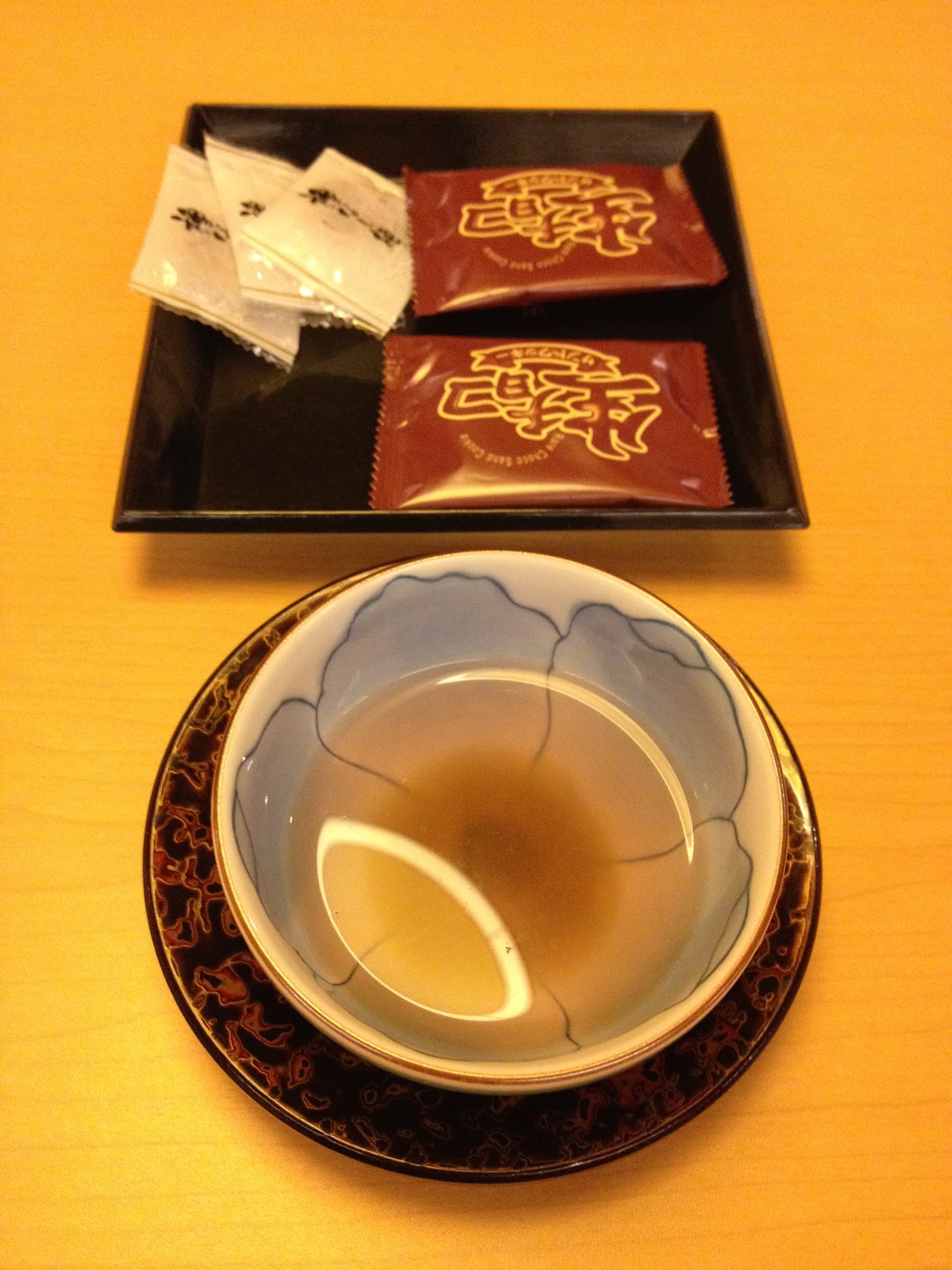
During our stay in this amazing Shiretoko Daiichi Hotel on the second day, I had the chance to try ume-konbu (japanese plum-konbu) tea since there were some tea bags provided in the room.

ume-konbu tea
Hm... I would say that it is not my favourite, hehe. It might be because I'm not used to tea with salty taste. It tasted a bit like soup to me.. hehe. However, it seems konbu tea is very popular in Japan. Being rich in trace minerals, konbu tea can also be used to add taste for cooking.